Blog

  • London 1979

    ted_image_1758336961.jpg” style=”width: 550px” title=”London17″ />
    Regents Canal, Camden

    London18
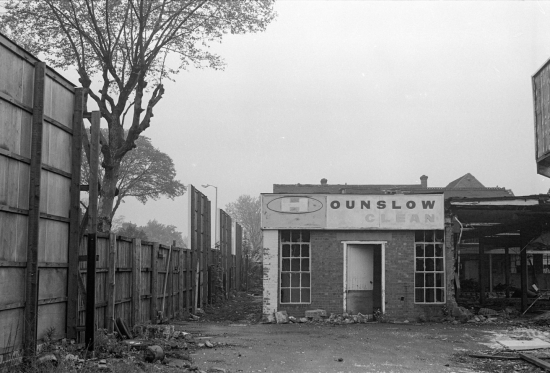
    Hounslow Laundry, Hounslow

    London20
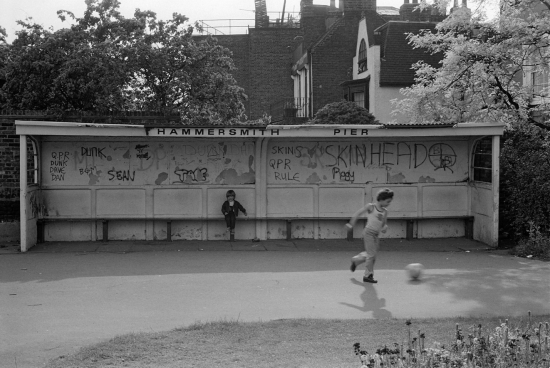
    Shelter, Hammersmith Pier

    London21
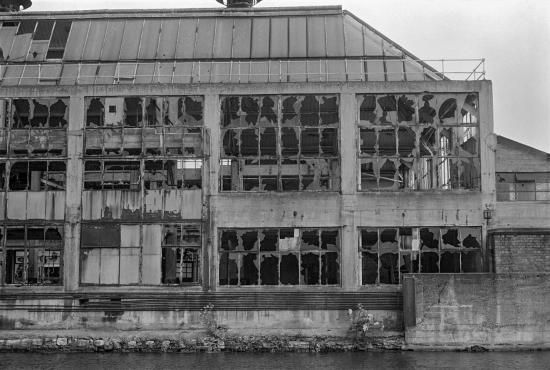
    Derelict Works, Wharf Rd, Regents Canal, Hackney

    London22
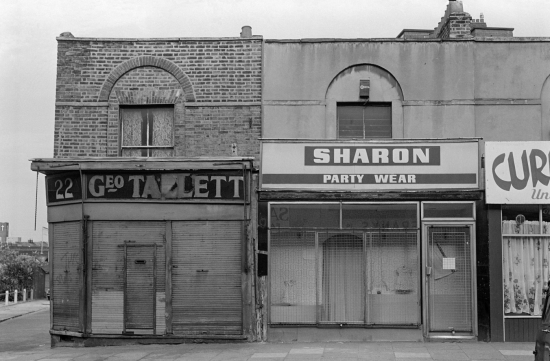
    Shops, Broadway Market, Hackney

    London23
    Garage, Brady St, Tower Hamlets

    London24
    Scrap Metal, Woodland St, Hackney
    [All photos © Peter Marshall]

    Peter Marshall previously:

    Hull in the 1970s and 1980s
    Writing on the wall
    Humberside colour
    London Cafes in the 1980s
    London cafes, again

  • One Step Beyond

    From another world. Another universe, even. Back when we used to have fun, and nothing mattered so much. Back in 1979, to be exact:

    [youtube=https://www.youtube.com/watch?v=SOJSM46nWwo&w=550&h=309]

    The YouTube comments are all "this is so British…", and they're not wrong, but of course the inspiration here is the late great Jamaican Cecil Bustamente Campbell, aka Prince Buster. Here's his original 1964 One Step Beyond, with Thirties dancers Wilson, Keppel and Betty providing the moves.

    And here are my thoughts from a few years back on why ska was so hugely influential on British youth culture, from the Specials to Madness, but reggae somehow wasn't. I suppose what I didn't perhaps emphasise enough in my ruminations is that whereas ska was straight-ahead good-time music, reggae was so closely tied in with Rastafarianism and the black experience in Jamaica that it would have been strange and inappropriate for white groups to take it on. Not that that stopped the Clash, with their execrable version of Police and Thieves.

    In fact even black British culture couldn't quite get a handle on reggae. Groups like Aswad and Steel Pulse were OK, but not really a patch on the Jamaican originals. The only genuine UK innovation was Lovers Rock, as Steve McQueen reminded us in last year's Small Axe film. The main song there, and Lovers Rock's biggest hit, was Janet Kay's Silly Games, and, I'm sorry, but, to put it kindly, she really wasn't a singer.

  • Promoting collective narratives of transformative resistance

    rough academic disciplines during the last few decades.

    The new curriculum, which will eventually be promulgated throughout the California school system of 6 million children, would “critique empire and its relationship to white supremacy, racism, patriarchy, cisheteropatriarchy, capitalism, ableism … and other forms of power and oppression,” according to the proposal. It would “build new possibilities for post-imperial life that promotes collective narratives of transformative resistance.”

    Capitalism was classified as a form of “power and oppression,” and although “classism, homophobia, Islamophobia, and transphobia” were also listed as forms of oppression, anti-Semitism was not. Jewish Americans were not even mentioned as a minority group.

    The thinking behind the ESMC, as well as the now fashionable teachings of critical race theory, go back to groups like the Black Student Union and the Third World Liberation Front, active in the 1968 San Francisco State College strike in 1968, which was a reaction to the sacking of a teacher named George Murray and led to the founding of the San Francisco State’s School of Ethnic Studies. 

    There is a straight line from the 1968 strike to today’s ESMC, whose text explicitly acknowledges its debt to the Third World Liberation Front. In a speech a week before his firing, George Murray, who also served as the minister of education for the Black Panther Party, declared the U.S. Constitution was a “lie” and the American flag was a “piece of toilet paper” deserving to be flushed. He also attacked Jewish people as “exploiters of the Negroes in America and South Africa” and called for “victory to the Arab people” over Israel.

    Many of the 18 people chosen by the State Board of Education’s Instructional Quality Committee to create the ESMC hail from San Francisco State’s School of Ethnic Studies, and most are adherents of the radical critical ethnic studies movement who refer to themselves as scholar-activists.

    Ah well. What was it they used to  say? What happens in California today happens in the rest of the US tomorrow, and then in the rest of the West….
  • Looking for America

    020 © Mark Power | Magnum Photos

    Power15
    Striggersville, Tennessee 12.2015 © Mark Power | Magnum Photos

    Power16
    Sycamore, Illinois 11.2017 © Mark Power | Magnum Photos

    Power previously here, here, here, and here.

  • Celebrated alumni

    eft: 40px”>But it’s [sic] proposal to include a plaque to the Soviet spy Donald Maclean – a member of the infamous Cambridge Five spy ring who passed classified information to the Soviet Union during the Cold War – among 25 former pupils has come under fire.

    What's the problem? He was famous, wasn't he? That's all that counts. "Get out there, chaps, and make your mark on the world. Write poems, compose music, invent a new type of vacuum cleaner, betray your country in the name of Stalin….just make your mark"

  • Homes of the Blues

    o: Shorpy/Walker Evans for the Resettlement Administration]

    Robert Johnson's Travelling Riverside Blues, recorded 1937:

    I got womens in Vicksburg, clean on into Tennessee
    I got womens in Vicksburg, clean on into Tennessee
    But my Friar's Point rider, now, hops all over me…

  • Grey day

    e98bb8f4200b img-responsive” src=”http://mickhartley.co.uk/wp-content/uploads/2021/01/mt_imported_image_1758337023.jpg” style=”width: 550px” title=”IMG_6710s” />

    IMG_6711s

    IMG_6717s2

  • Our Dear Native Home

    f=”https://mickhartley.typepad.com/blog/2016/12/everything-is-going-according-to-plan.html”>grim satire on the horrors of a true socialist system. Of course such a system was indeed foretold, as Christopher Hitchens memorably reminded us, by Orwell:

    The North Korean state was founded in 1950/51. That's the year 1984 was published for the first time. You think, could it be that someone handed a Korean translation to Kim il Sung and said, "Do you think we could make this fly?"… 

    I was reminded of that earlier post by this item in today's Rodong Sinmun.

    New Novel Published in DPRK.

    Well then. What dramatic tale could this be? But of course we know exactly the kind of dramatic tale that this is:

    The full-length novel "Our Dear Native Home" (authored by Kwak Song Ho), part of the serial "Immortal Guidance", was published.

    The novel deals with the immortal exploits Chairman Kim Jong Il performed by putting efforts into the strengthening of the companies of the People's Army, the basic requirement for developing it into the pillar of the revolution and the main force for accomplishing the revolutionary cause of Juche, and by turning them into dear native homes for soldiers.

    The novel notes that a revolution was witnessed in transforming all the companies of the army into the cradle of worthwhile life where soldiers cultivate their bravery and perform feats, and into their dear native homes under the care of the Supreme Command, thanks to the guidance of the Chairman who took warm loving care of soldiers.

    Though I suppose it does have the defining attribute of a novel: it's complete fiction.

  • Britain in passing

    0px” title=”Howorth-10″ />

    Howorth-11

    Howorth-14

    Howorth-13

    Howorth-12
    [Photos © Ian Howorth]

    On Instagram.

  • We Sing of the Party

    rformance "We Sing of Party" Celebrates 8th Congress of WPK:

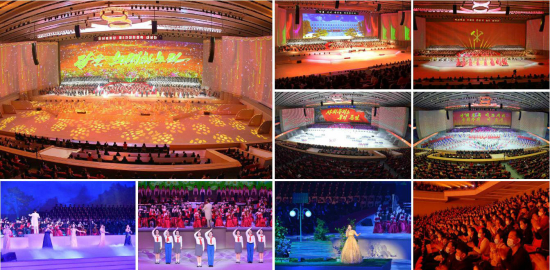
    The grand art performance "We Sing of the Party" drew a full house at the Pyongyang Indoor Stadium. It was given from Jan. 13 to 24 to celebrate the 8th Congress of the Workers' Party of Korea.

    Working people in the city enjoyed the performance.

    The performers, who represented a sublime music world with hymns of the times heartily sung by our people for centuries in reverence for the great Party, put on the stage special numbers to impressively depict the immortal feats of the invincible WPK that has led the cause of socialism to a shining victory.

    Watching the performance, the audience keenly realized that the prosperity and development of the country came to be achieved, thanks to the wise leadership of the Party regarding the people-first principle as its basic idea and guiding idea.

    The performance boosted the morale of our people who turned out in the revolutionary struggle for the overall development of our own-style socialism, true to the ideals of "The people are God", single-minded unity and self-reliance.

    Sing-party_image